Wednesday, April 9, 2014
Our Replacement Has Arrived!
So many people have asked who would take over our job once we left our village. Peace Corps Zambia has what is called a "3 generation" model. Ideally, there are three two-year volunteers back to back over the course of 6 years. In a perfect example, the volunteers have introduced "sustainable" change/skills to the community, so that after the six years, the community will not have any more need for Peace Corps. Of course this model is often interrupted by changes within Peace Corps or the village itself. Since we were first generation (i.e. there had not been other previous volunteers at our site), we pressed hard to get a replacement volunteer since we knew there was still plenty of work to be done. Knowing the possibility of being replaced by another married couple was rare (there just aren't enough of us!), we advocated for a single fish-farming volunteer to take over our site.
Well, we just got our wish and would like to welcome Kenny as the new Rural Aquaculture Improvement volunteer to our site. He will officially swear-in at the beginning of May. Out with the old, in with the new! In this day and age of technology, which is rapidly increasing in Zambia, Kenny has already begun his blog to chronicle his journey in the Northwest Province of Zambia:
http://kj0505.wordpress.com/
Welcome Kenny, and we know you'll have an incredible time!

Tuesday, January 21, 2014
Books! (Gina's Post)
One gift Peace Corps Zambia gave us was the opportunity to read lots of books. With no electricity or internet to distract us and plenty of time on buses, I probably read more books there than in high school and college combined. Many thanks to friends who sent reading materials and to volunteer organizers of the amazing Solwezi house lending library. Here's a pretty complete list of the books I read while in Zambia:
1) Nine Hills to Nambokaha
2) Eat, Pray, Love
3) The Ponds of Kalambayi
4) The Celestine Vision
5) Saving Fish from Drowning
6) Where There's no Toilet Paper: Traveler's Tales
7) Animal, Vegetable, Miracle
8) In Patagonia
9) The Secret Life of Bees
10) One Hand Does Not Catch a Buffalo
11) The Sun Also Rises
12) A Long Way Gone
13) The Celestine Prophecy
14) The Help
15) Ishmael
16) The Poisenwood Bible
17) Strength in What Remains
18) Dead Aid
19) Raising Goats for Dummies
20) Cutting for Stone
21) Set This House in Order
22) Don't Let's Go to the Dogs Tonight
23) A Time to Kill
24) Mango Elephants in the Sun
25) The Air We Breathe
26) The Dead Zone
27) The Hithiker's Guide to the Galaxy
28) The Life and Times of Michael K.
29) The Dark Star Safari
30) The Lacuna
31) Water for Elephants
32) Leaf Storm
33) Africa: A Continent Self-Destructs
34) Travel as a Political Act
35) The Trial
36) Monique and the Mango Rains
37) The Testament
38) The Divine Secrets of the Ya-Ya Sisterhood
39) The Story of Beautiful Girl
40) Norwegian Wood
41) The Boy Who Harnessed the Wing
42) Pecked to Death by Ducks
43) Glimmers of Hope: A Memoir of Zambia
44) The Life of Pi
45) Persuasion
46) What Should I Do With my Life?
47) On Writing
48) The Three Letter Plague
49) A New Earth
50) Hearts in Atlantis
51) The Joy Luck Club
52) The Unheard
53) Island Beneath the Sea
54) The Alchemist
55) Join In: Multiethnic Short Stories
56) Slaughterhouse Five
57) Rich Dad, Poor Dad
58) The Tipping Point
59) 11-22-63
So of course there were lots of books about Zambia and Africa, which I found extremely interesting being then and there. Other things I've learned: I'm still not a fan of sci-fi, an occasional classic is good for building character, and I'm much more a fan of general fiction than I used to be. Favorite authors from my Zambia stint: Stephen King, Barbara Kingsolver, Abraham Verghese, and Amy Tan. Hope I continue this reading trend that Zambia has taught me!
1) Nine Hills to Nambokaha
2) Eat, Pray, Love
3) The Ponds of Kalambayi
4) The Celestine Vision
5) Saving Fish from Drowning
6) Where There's no Toilet Paper: Traveler's Tales
7) Animal, Vegetable, Miracle
8) In Patagonia
9) The Secret Life of Bees
10) One Hand Does Not Catch a Buffalo
11) The Sun Also Rises
12) A Long Way Gone
13) The Celestine Prophecy
14) The Help
15) Ishmael
16) The Poisenwood Bible
17) Strength in What Remains
18) Dead Aid
19) Raising Goats for Dummies
20) Cutting for Stone
21) Set This House in Order
22) Don't Let's Go to the Dogs Tonight
23) A Time to Kill
24) Mango Elephants in the Sun
25) The Air We Breathe
26) The Dead Zone
27) The Hithiker's Guide to the Galaxy
28) The Life and Times of Michael K.
29) The Dark Star Safari
30) The Lacuna
31) Water for Elephants
32) Leaf Storm
33) Africa: A Continent Self-Destructs
34) Travel as a Political Act
35) The Trial
36) Monique and the Mango Rains
37) The Testament
38) The Divine Secrets of the Ya-Ya Sisterhood
39) The Story of Beautiful Girl
40) Norwegian Wood
41) The Boy Who Harnessed the Wing
42) Pecked to Death by Ducks
43) Glimmers of Hope: A Memoir of Zambia
44) The Life of Pi
45) Persuasion
46) What Should I Do With my Life?
47) On Writing
48) The Three Letter Plague
49) A New Earth
50) Hearts in Atlantis
51) The Joy Luck Club
52) The Unheard
53) Island Beneath the Sea
54) The Alchemist
55) Join In: Multiethnic Short Stories
56) Slaughterhouse Five
57) Rich Dad, Poor Dad
58) The Tipping Point
59) 11-22-63
So of course there were lots of books about Zambia and Africa, which I found extremely interesting being then and there. Other things I've learned: I'm still not a fan of sci-fi, an occasional classic is good for building character, and I'm much more a fan of general fiction than I used to be. Favorite authors from my Zambia stint: Stephen King, Barbara Kingsolver, Abraham Verghese, and Amy Tan. Hope I continue this reading trend that Zambia has taught me!
Sunday, January 19, 2014
Slideshow of our Service
Please feel free to look at this slideshow, which gives a picture of our entire service. If you're interested in having one or both of us present at your school or community event, let us know!
 | Zambia Slideshow |
After you get on the link, please click on "present" and then "present from beginning" on the upper right-hand corner and click on each page for your viewing pleasure! Enjoy.
Wednesday, January 8, 2014
Hut Videos
Many of you wondered what our hut was like, so here are some videos that Scott took now that we actually have internet speed that will allow us to upload them!
Friday, December 13, 2013
Gina's Reverse Culture Shock Experience #2
I don’t really know if this is a separate experience since
it also involves phones, but it happened my 2nd day in Americaland,
so I decided to break my techno-phobe blog into two parts. Well, realized we could not for even
one day exist as Americans living in America without Smartphones, so the first
item on the agenda (after a morning detour to snorkel and watch sea turtles at
a beautiful beach) was to have our gadget-savvy friend Chris help us buy
Smartphones at the local Kauai mall.
Before I get further with this post, I must make a little
confession. I am a
Smartphone-virgin. Before we left
for Peace Corps and they were getting crazily popular, I was the hold-out
because I didn’t want to start another contract only to have to break it months
later. In Zambia they become
somewhat popular in the city, but we had such minimal network coverage in the
bush that buying such an expensive device would have been a waste of our living
allowance. So no, I have never in
my life owned a device that has a touch screen, music streaming capabilities,
or a built-in planner. I have
never in my life downloaded an app.
Just to see what was on the market, we looked online before
the big purchase, because of course as unemployed RPCV’s (returned Peace Corps
volunteers) we had little disposable income for fancy bells and whistles or
expensive monthly fees. We found
that the iphones came out in 4-something and 5-something models, different
memory capacities, and a variety of colors. Of course there were also many iphone knock-off that of
course had the same capacities but were a lot less money. My head was already starting to spin
from so many choices.
We got to the mall playing lovely Hawaiian Christmas tunes,
and a Verizon representative greeted us the minute we entered the door. He personally shook our hands, took
down our names, and told us there were 3 other parties waiting before us. Now that’s customer service! He said we could browse all the
available models and ask our representative if we had any questions. I didn’t look at any and just wanted
the experience to be over, so I stepped out to use the restroom while we were
waiting for the sales representative.
When I returned, I saw that Chris and Scott were already chatting it up
with the representative. He was
showing us all the newest and greatest versions of iphones.
Luckily our gadget-savvy friend was able to ask, “but what
about all those iphone 4’s, the older model, are you still selling those?”
“Why yes, yes we are.”
“Well they aren’t at the display counter.”
“Well we’re selling them and they cost 99 cents each when
you get a plan.”
Knowing that a iphone 4-something would be just as
incredible as an iphone 5-something tour our Smartphone-virgin fingers (we’d
never experienced versions 1, 2, or 3), Scott and I opted for the budget
variety rather than the lastet-and-greatest that would cost us $100-200
extra. After all, we didn’t really
know what we were missing.
Crazily, the fine print noted that the 99-cent devices we were
purchasing were worth something like $549 apiece, presumably paid for in the
exhorbitant month-by-month fee. I
did not even want to do the math, but by the time the 2 years is up, we will
have paid Verizon well over $2,000, about half a year’s stipend when we were
living in Zambia. “We just better
not make sure they get lost or broken, since we’ll have to go back to flip
phones until our plan ends.” We
were appreciative of Chris’s research, which saved us at least $200, since we
didn’t even know the hidden older versions were for sale.
The funniest thing was at the checkout counter when we were
asking all sorts of questions and googly-eyed like kids who just got to pre-buy
their Christmas presents. We both
had to get new phone numbers.
“Sorry,” I told the clerk “we haven’t had phones for the
past 2 ½ years.”
She looked at me blankly like “which planet did you come
from?”
I further explained, “ we were living in Africa for the past
few years and just used this little thing” as I pulled out my old little Nokia
and explained how easy it was to fill the thing up with minutes of prepaid
talk-time.
She laughed, and by this time, several other salespeople
gathered around us like they couldn’t believe their eyes that people actually lived without a Smartphone. We were so excited to be getting
Smartphones that I think all the customers looked to see what all the fuss was
about.
We walked out and I started driving as Scott immediately
tested his new GPS and was so enthralled with the program that we missed
several key turns. I vowed that I
was going to use mine for phone calls only while in Kauai so as not to detract
from the experience of this beautiful island, so I didn’t even turn mine on.
Then . . . not
a creature was stirring all through the house we were staying at and I tiptoed
downstairs at 1:30 in the morning, wide awake thanks to jet lag from
Thailand. What to do? I picked up my book and quickly put it
down. Then I picked up the magical
Smartphone, found my way to Facebook, where I could actually look at pictures
and type messages, and experienced love with my Smartphone for the very first
time.
Gina’s Reverse Culture Shock Experience #1
We were warned by Peace Corps that it would happen. Coming home, they said, would be much
more of an adjustment than going to Zambia. You wouldn’t have the luxury of a 3-month “training period”
where people would teach you cultural norms. And quite frankly, after living abroad for so long (29
months to be exact) without stepping foot on American soil, some of the things that
people do just wouldn’t make sense.
Even in your home culture . . .
After two short overnight flights crossing several time
zones bordered by a 14-hour layover in Korea, I knew conditions were ripe for
an emotional meltdown. Well, it
happened in the Kauai airport shortly after arriving in paradise . . . over the
subject of cell phones.
Rewind to the last four countries we’ve been to: Zambia,
Malawi, Ethiopia, and Thailand. My
nifty little 9-key Nokia phone worked in all those places without problem. In fact, within hours of being in each
new country, I could pick up $2 pre-paid simcard at any convenience store or
market stall with one of the local networks and start contacting anyone I
needed. No models to choose from,
data plans to select, setting up online user accounts or billing options. Register your card at the shop with a
valid ID (sometimes), put in your fingernail-sized card that you just bought
and go! No problem.
Now fast-forward to the perceived luck Scott and I had of
getting to Kauai 5 hours EARLIER than expected because there was room on a
standby flight. All we wanted to
do after nearly 48 hours of continual travel was find our friends Chris and
Yuki’s house and crash. Problem
was, both of our drivers’ licenses had expired while in Zambia, and I had my
renewed one mailed to their house.
They didn’t know we were going to arrive 5 hours over to meet us at the
airport with license in hand so we could actually rent a car. Another culture shock as this was the
first place you actually needed a
driver’s license to get where you wanted to go. No tuk-tuks or taxis just waiting to pick people up.
Problem with calling our friends to tell them we arrived
early was . . . phone didn’t work at all.
No network signal on my cheap multinational ZamPhone, and no convenience
stores to buy a $2 simcard. God
bless America. I was going to ask
fellow passengers if I could borrow a phone for a second to make a quick call,
but by the time we got out of the “no cell” area, people were dispersed and
busy with their baggage pickup and hotel and rental car shuttles. I lugged out the computer hoping for a
wireless network like they had in all the other airports we were in, but of
course there was none. God bless
America. How were we going to get
a hold of our friends, who had out-of-state cell phones as many Americans
do? Why a pay phone of
course. Never mind we had no
American change, and knew a non-local call would be expensive. The airport information lady politely
informed us that there were no longer pay phones in the airport. She was happy to let me use her
landline to make a local call, but unfortunately the number I had wasn’t
local. That’s when the meltdown happened.
I laid on the bench of the now-empty airport as all my other
fellow passengers had grabbed their rental cars to explore paradise, and let
Scott try to figure out how the heck to reach our friends. After a few minutes trying the TSA
people and a few other employees, no luck. No employees would let us borrow their cell phone, probably
as a matter of national security or something. So . . . we did all we could think of and took the shuttle
to the rental car place, knowing we’d be stuck until our friends delivered my
license.
Luckily, the car rental agency wasn’t as strict as the TSA
and would let us make a call to a long-distance cell phone so I could actually
get a driver’s license and get some real sleep. We got a hold of Yuki, who was so excited we were there, but
was not expecting us that early and had some obligations, and said she would
call when she was able pick us up.
“Can I just call you at the number that you texted us a few
days ago?” she asked
“No, that’s our Thailand phone.”
“Oh, then how will you know when I’m coming?”
“Um . . . just call the rental car 1-800 number and hope you
can get through?”
What did we do
before cell phones?
After what seemed like hours of sitting on the bench
watching tourist after tourist getting their wheels for paradise, the another
sales agent said, “well what are you waiting for?”
“My driver’s license.”
“Oh, that’s important.”
“Could I at least start the car rental paperwork now?”
“No, we have to see your license first.”
When Yuki finally got through to the 1-800 number and
arrived at the car rental place, she gave me the magic envelope with my brand
new license that I renewed online through WA state. I gave it to the lady still stuck to the original letter,
neglecting to explain that I had less than 4 solid hours of sleep in the last
48 hours and also that I hadn’t driven a single vehicle for the past 29 months.
“Just pick any compact car from the parking lot. The keys are in the door.”
And it was as easy as that. Aloha and welcome back to the USA.
Korean Interlude (Gina's post)
I was quite dreading going to Korea. We chose the cheapest way of
getting from Thailand to Hawaii, which meant a 5-hour overnight flight to
Incheon (near Seoul), Korea, a 14-hour layover at that airport, and a 7-hour
overnight flight to Honolulu. Not
only a crazy journey, but we would start and end it on the same DAY due to
crossing the international date line, as if being herded around the world never
happened. It would literally be
the longest day of our lives, and all I could think about was getting some sort
of hotel in Korea during the long layover so we weren’t completely exhausted
when we arrived in Hawaii.
I called the airlines to see if they would provide a hotel
room because of the long layover.
The lady at the call center politely stated that unfortunately the
airline wouldn’t be able to cover that expense since they were booked through a
budget website (gotta love Budgetair).
So, I got online to book a room near the airport myself. That’s when I did a little research to find
out all the things that the Incheon airport has to offer.
Of course, first priority was probably sleep, so I was
excited to see a blog to show that the airport was highly rated in the world
among airports where you could actually get decent rest. They had several passenger lounges with
reclining seats and long benches without those annoying armrests. Incheon also offers free massage
chairs, a TV lounge, and showers so passengers in transit can literally make
themselves at home.
 |
| Scott catching some zzz's in between flights. |

Then . . . I saw the clincher which changed my mind from
booking a hotel room—Incheon airport offers tours of Seoul for passengers on a
layover. That’s right. You just get off your plane, show them
your boarding pass for the next flight, and they whisk you away to see some of
the city sites before your next flight.
When we actually arrived, we went straight to the lounge to
get a couple hours sleep as planned.
While Scott continued to nap, I explored the arts and crafts center,
where passengers could do traditional Korean crafts for free and checked my
e-mail. Scott was impressed by the
Korean language exhibition that gave a very informative lesson how the alphabet
developed after the Japanese occupation.
With more than seven hours remaining at the airport, we decided that
we’d go on the 5-hour afternoon day tour and went to the information booth to
see how much it would cost us. On
the way, we saw traditionally-clothed airport employees processing through the
airport in some sort of parade.
When we finally found the day tour desk, the attendant said we only had
to pay for lunch and the temple entrance fees. Transport and a guide were FREE, courtesy of the airport. He showed us how to go backward through
the customs line (a little awkward) to get some type of a day permit on our
passports. We found ourselves in a
mini van with our guide, Kim, a slight middle-aged woman, and one other tourist
from LA who had a layover in Korea from the Phillipines.
 |
| Cultural parade. |
 |
| Scott and I visiting one of the colorful palaces. |
The hour-long trip from Incheon to Seoul reminded me much of
the Pacific Northwest with misty grey skies parting for some bursts of blue and looming mountains in the
background. Kim said that hiking
is very popular with the Seoul locals on the weekends. We also crossed a large river with
residents jogging, cycling, and utilizing park exercise equipment along its
banks. Kim explained the city’s
history and politely answered any questions we had about the city. We stopped at Changdoek Palace, a very
well-maintained former royal palace housed in the city center that was
reconstructed after the Japanese occupation and an active Buddhist temple in
the city center. After coming from
Thailand, I thought I had my fill of temples, but this was the first one where
we saw an active prayer ceremony.
Kim said Korea hosts a fairly even mix of Christians and Buddhists, with
some agnostics thrown in as well.
We ended the tour at Seoul’s Insadong street and ate a traditional
Korean meal of soup, and rice with a bunch of toppings that Kim told us to add
one-by-one and keep stirring and stirring. Although she gave us time for “shopping,” Scott and I
thought we were weighed down with enough stuff from Zambia, Ethiopia, and
Thailand. The chill in the air
reminded me that I had no warm clothes, so I picked up a pair of flannel-lined
pants and a purse.
 |
| Eating traditional Korean food. |
 |
| University freshman practicing their English by asking Scott questions about his impressions of Korea. "Well, I've only been here 5 hours, but . . . your airport is really nice!" |
We jumped back in the van ready to get back to the airport
with a few hours to spare before our next overnight flight to Honolulu. We stopped on our way back to the
relaxation lounge to see a free opera concert happening in the main terminal! After passing through the fastest
security line that I’ve ever been to at any airport in my life, we were back at
the terminal with time for a hot shower before our next flight. They even provided the shampoo, soap,
and hair dryer at no charge.
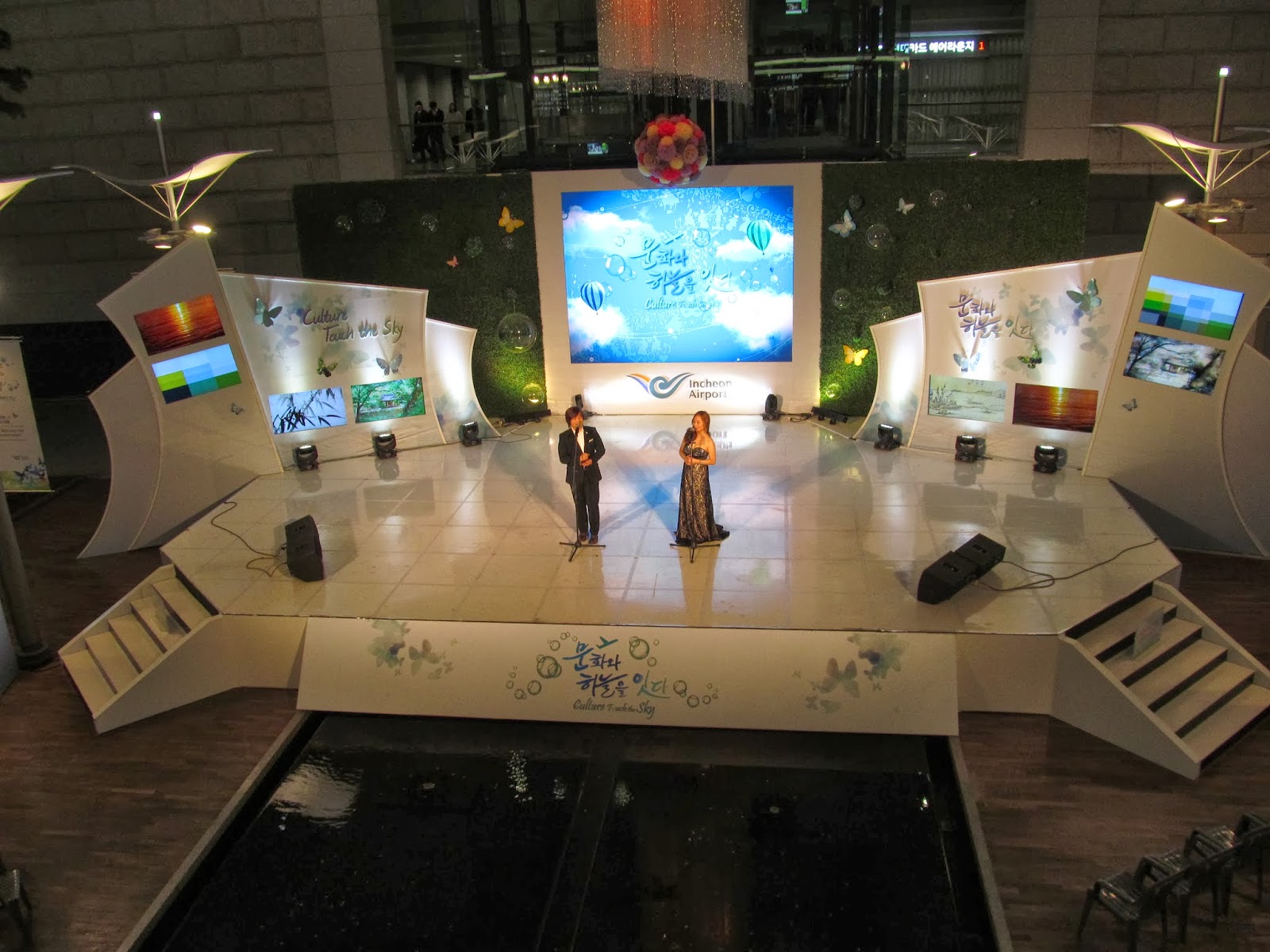 |
| Opera in the main terminal seems to be a daily event. |
So, if you just happen to have a 14-hour layover in Korea .
. . fear not. You will have PLENTY
to do, or not do. I would
definitely rate it as the best airport experience of my life, even through it
was on the longest day of my life :).
Tuesday, December 10, 2013
Southern Thailand

Gina and I took the sleeper train from Bangkok to southern Thailand. It was the first time I had been on a sleeper train but I was so tired that I was asleep for about 99% of the trip so I don't remember much except that it was similar to being constantly being shaken in my mother's arms as a small child.


Kayaking brought us up close and personal with wave-carved karst outcroppings like this one.

Long boats are the way to get back and forth from the nearest large town, Krabi, and the Railay beach. There is a road but no self-respecting tourists take it.


Monday, December 2, 2013
Thailand Tidbits (Gina's Post)
Gina’s Thailand Post
We knew we were on a completely different continent the
moment we stepped off the plane . . . mostly because for the first time in a
very long time we didn’t have to disembark the plane via steps onto the
tarmac. There was actually a
tunnel that connected straight to the Bangkok airport! After the customs lady politely
informed us that we needed to go back through the Yellow Fever line since we
were coming from Africa. When we
were all cleared for that, we put a bag in the airport storage, and headed for
the Sky Train. Even after the
exhaustion of the overnight flight, Scott and I couldn’t help but marvel at the
efficiency of moving people from one place to another in Bangkok. The train was
so smooth and just whizzed over traffic!
We got to the northernmost stop on the line and headed for the bus
station to Chiang Mai via taxi. No
bartering over muzungu prices . . . just a meter that told us how much we owed.
At the bus station, we had our first taste of local Thai
food and were awed by the various noodle and rice bowls with different types of
meat or curries available. Just
like Ethiopia, the vendors couldn’t speak a word of English, so it was more of
a “point and choose” type of game, but for around $1 per meal, couldn’t complain. We were also surprised by the number of
locals eating at KFC next door, but we did not want to venture yet into
American chain stores.
Scott posted about the luxurious 1st class VIP
bus on the way, so I’ll spare the details on that one, but let’s just say that
we took a 2nd class double-decker bus on the way back to Bangkok
that wasn’t nearly as nice, so Thailand isn’t a complete fairy tale. Anyway, we arrived in Chiang Mai that
morning feeling like we actually got some real sleep, and immediately started
walking around the city. The most
amazing thing coming from Zambia and Ethiopia was the sheer variety of
restaurants and retail stores packed into such a small space. There were Thai massage, haircuts, travel agencies, high-end
purses, street food vendors, Thai handicrafts, coffee shops, McDonald’s and organic
places where you could get a full American breakfast all within a few compact
blocks. There were people walking
around the streets from every country you could imagine, and besides Disneyland,
I hadn’t seen so many foreigners in one place in my life. There were also giant temples and
yellow-robed monks to complete the picture. The second thing we did in Chiang Mai was take almost all of
our completely worn-out Africa clothes to a proper Laundromat to see if some of
the red dirt and grime could be mechanically washed out of them. So exciting not to have to wash clothes
by hand!
The next few days in Chiang Mai were spent gawking at every
consumer item available for sale, visiting some temples and cultural sites, and
eating real breakfast with coffee every morning. That was topped off by Thai massages, a rooftop swimming
pool experience and a hike to the surrounding mountains where we were able be
herded through a “traditional” Thai rural village. We also tried to rest during the days, since the evenings
were like 4th of July for five days in a row. Locals and tourists alike gathered in
the streets and on the riverbanks to set off firecrackers, release floating
lanterns, and make little boats called krathongs as an offering to the river
gods. Most of the activity
happened in the evenings near the riverbank, but the evening with the most
activity had a Thai beauty pageant and parade through town. One evening when we met up with our
Peace Corps Zambia friends Chad and Jenna, Scott and I tried our own hand at
releasing a lantern, and we were proud to say it raised itself into the sky
without crashing and burning in the neighboring trees like so many others were
doing. Many of the temples were open
during festival nights as well to show visitors Thai music, dancing, and the
ancient craft of spinning and weaving the monks’ robes. Although a bit overwhelming to the
senses at first, Chiang Mai had a magical spirit that especially came to life
during the evenings of the Loy Krathong festival.
But alas, we headed back to Bangkok on an overnight bus that
was about 20 times worse than the one we arrived in and broke down several
times along the way. Then, it
started raining outside and on us through
a leak in the vent of the upper story of this double-decker bus. So, can’t give props for all buses in Thailand, but the latter was booked through a travel
agent in Chiang Mai, so buyer beware! We hopped on the Sky Train to the train
station, where I thought we’d be waiting around all day for our overnight train
down south. In an unexpectedly
surprising day, we found that the Bangkok train station had both secure luggage
storage and was located very near the central part of town (totally unheard of
for African bus stations), so it would be silly not to explore the city for the
day, even in our groggy state.
After nearly losing our lives crossing about 6 lanes of
traffic coming out of the Bangkok train station, a helpful businessman directed
us to an old canal to follow that would lead us to the river. From there, we could take the public
river taxi for about 50 cents to the Grand Palace. Scott and I had no idea that was going to be our destination
that day, but after glancing at the Lonely Planet, we realized it was one of
those must-see tourist sites for every visitor to Bangkok. And probably about 1,000 other people
had the same idea that day, from backpackers to people in huge tour buses. Scott said the lines and excitement for
seeing this royal enclosure rivaled Buckingham Palace in London. Luckily we both happened to be wearing
full-length pants from the bus ride because the palace dress code wouldn’t
accept anything shorter for guys or gals . . . about half the tourists had to
buy Thai-style trousers from hawkers at the gate. It was easy to become lost among the crowd, but even easier
to become lost among the gorgeous temples and Buddhist murals found in the
temple enclosure, or the royal palaces that housed (and still house) kings and
diplomats.
We tried to make our way to another park with tourist
attractions, but fatigue from the overnight bus got a hold of us, so we
wandered back through Chinatown on the way to the train station and ate plenty
of delicious street food along the way.
The train itself was a long chain of sleeper cars that slept 16-20
people each filled with locals and tourists alike. They gave us fresh sheets, pillows, and curtains for privacy
and Scott and I soon passed out as we slowly chugged our way to Southern
Thailand. The morning light
through the open window revealed humid air and lush green scenery before
stopping at Surat Thani, a sleepy southern Thai town with absolutely no tourist
attractions and plenty of pouring rain.
Our beach destination for southern Thailand: the Golden
Buddha Beach Resort, an eco-lodge on the on a deserted 12-km beach on island of
Koh Phra Thong on the Andaman sea.
Because of the boat schedule, we stayed inland in the small city of
Takua Pa, and were treated to a $10/night room with a balcony, delicious street
food and very friendly locals.
Because we were absolutely the only tourists around, we definitely had
to use pointing gestures for food as we stumbled across a delicious local
restaurant serving dessert Thai pancakes.
Yum! Finally we made our
way on a local bus to the pier for the Golden Buddha Beach Resort, and hopped
on a longtail boat which dropped us on a crescent-shaped beach with long lines
of coconut groves and not another soul in sight reminiscent of a desert island
in the movies. The next five
nights blended together with amazing images of long desolate walks on the
beach, twice-daily yoga, swimming in warm turquoise water, mischievous monkeys
trying to break open coconuts on rocks, and intermittent thunderstorms and sun. We slept every night in a
treehouse-like bungalow complete with king-sized bed and hardwood carvings and
awoke to the sound of waves crashing against the shore. After hearing about Thailand’s crowded
beach resorts, I wasn’t sure a place like this existed, but indeed it
does. Paradise!
Unfortunately the reverie was broken mostly by budget and
the need to make it back to Bangkok and on toward home. Scott chose one more beach destination
before we left, which was Railay, famous for having over 500 bolted rock-climbing
routes and huge columns of rocks called karsts jutting out of the ocean. Just like the palace in Bangkok, it was
far too many muzungos in one place, all showing more skin than we’d seen in the
past 2 ½ years, mostly with accompanying young, tan, chiseled bodies. At least we were able to do most of the
advertised adventure activities, including rock climbing, kayaking, and
snorkeling, all within walking distance from our cookie-cutter hotel. We spent Thanksgiving night searching
for some type of American food place,
but alas, only found a restaurant that advertised minestrone soup, which turned
out to be a vegetable broth, said to each other what we were thankful for, and
ended the evening with cocktails in the rain on an anchored boat restaurant. Definitely a Thanksgiving to remember!
We took one more overnight bus back to Bangkok, this time
one that didn’t have individual TV screens, but the recliner seats had a
massage option! It dumped us at
4am at a random bus station, but at least I saw the early morning crowd
exercising at Mo Chit park, which reminded us of Central Park. We took a shot at Couchsurfing Bangkok
and got a local perspective of the city from the top of a penthouse on the 22nd
floor, and walked to the nearest shopping mall for a little more “readjustment”
to American culture. And we got it
. . . between Annie’s Pretzels, Dunkin’ Donuts, and a 5-story Christmas tree,
this 7-story mall was buzzing with both shoppers and Thais out to see and be
seen. We watched the Hunger Games,
the first show we’d seen in a movie theater for about a year and stood up with
the rest of the audience after the 20 minutes of ads/previews to salute the
King of Thailand during a song and slideshow. As we left the
theater, we again gawked at the consumer-driven Christmas culture, but did end
up buying a few gifts of our own!
Definitely a stark difference from Ethiopia just a few weeks before,
where Christmas (January 7th) is spent praying and giving gifts to
the poor.
There were rumors of riots in Bangkok from opposing parties,
so we decided to stay away from the city center for our last day there. Unfortunate, because the palace/river
was beautiful and we were hoping to spend another day there. Anyway, we rented a hotel to rest
before two overnight flights surrounded by the longest day of our lives—December
3rd, which probably lasted around 48 hours due to crossing the
international date line.
And ready to set foot on American soil for the first time in
29 months!
Monday, November 25, 2013
Northern Thailand

In Chiang Mai, during the Loi Krathong festival, I’d never
seen so many different kids of meat on a stick.

During the Loi Krathong festival, the Buddhist temples in Chiang Mai, and many larger cities in Thailand, were all lit up and many were open to visitors.

Even at the temples, people were invited to take part in the Loi Krathong festival. This part of it involved lighting a lantern/air balloon and letting it rise into the night sky. I never got a good explanation for the lanterns but the “river wreaths”, also lit with candles but let free onto the river, were meant to be “thanks to the river goddess for providing life to the fields and forests and asks for forgiveness for the polluting ways of humans (Lonely Planet 2012). Apparently the river goddess doesn’t mind all the styrofoam, wax candles, and other bits of plastic on the wreaths that have been jettisoned into her river.

During the Loi Krathong festival, the real stars that you can’t see because of the big city lights are replaced with thousands of candle lanterns set off by Thais and tourists alike.

Ancillary to the Loi Krathong festival is a parade showing off Thai tradition and culture. Like the lanterns and river wreaths, the show is on at night!

Parade detail

If the river recedes after the nighttime festivities of the Loi Krathong festival, the banks are covered in the debris of wreaths.

Buddhist temples are always extravagantly ornamented, dragons being a recurring theme. Another reoccurring but not necessarily ubiquitous theme is a sign at the entrance to the temples that reads “no women allowed”. Apparently they don't want the monks to be "tempted."

On a day-trip north of Chiang Mai, Gina crosses a stream for
a chance to swim in a waterfall pool.

Wat Phra Kaew in Bangkok is the name of the compound that includes the
Temple of the Emerald Buddha and the monarch of Thailand’s residence. It’s kind of like a somber-feeling
Disney World in that you are surrounded by architectural eye-candy, BUT in a religious setting.

Wat Phra Kaew, in the religious bit.


Wat Phra Kaew, but buildings related to the King and everything monarchial.

The food in Thailand has been consistently good everywhere
from high-end tourist restaurants to these outdoor stands where you get all
this for $1 dollar (30 bhat).
Friday, November 15, 2013
An African Traveler's Dream (Scott's)
Gina posted about bus travel in Zambia some time ago. Bus travel in Ethiopia was marginally
better. Now, contrast that to bus
travel in Thailand. The first
thing one notices is that the bus stations are real-deal bus hubs, with bus
platforms and food courts, clean bathrooms (but you still have to pay for their
use), TV’s with news and music
videos and commercials featuring bright red shiny tractors, and ticket booths
with computers and price lists.
The bus stations in Zambia were little more than dirt patches surrounded
by tin sheet and concrete shacks.
Now get on the bus.
In our case that was about 8:45 pm for a 9 pm start time. Instead of 5 seats across (3 seats and
2 seats with an aisle in the middle) there are 3 seats (2 seats and 1 seat
separated by an aisle) in about the same width of bus that boasts clearly that
it is 15 meters long. These are
similar to first class airplane seats.
There is a bathroom on the bus (which turned out not to be a great thing
by the end of the trip after it got used), personal TVs installed in the seat
in front of you complete with movies, videos, tourist attractions, games (yay
Sudoku!), fully reclining seats, pillows, blankets, and headphones in the seat
pocket.

The bus starts off on time. The bus doesn’t swerve every few minutes to avoid potholes,
goats, or children in the road.
You get a little box of convenience foods and bottled water delivered to
your seat shortly after starting off.
There is a 36-inch TV in front of the bus with announcements about what
to expect on your bus ride, followed by Thai music videos, and then turns off
around midnight to let those who want to sleep to do so while others continue to
be entertained by their personal TV.
Half-way through the trip there is a half-hour stop where you actually
have time to go the bathroom AND get something to eat, which can be paid for
with your bus ticket meal voucher, no extra charge! When you get off the bus to stretch you don’t get hassled by
three guys trying to sell you a taxi ride, sunglasses, or some disgusting meat
product in an open plastic bag.
You DO have many different food options in a clean food court and no one
hardly takes notice of you unless you ask them a question, at which time they
become very serious in their effort to try to help you using hand gestures and
pointing since no one knows English.
After you get back on the bus which you are actually looking forward to
doing because it’s so comfortable and there is on-bus entertainment and have
finished your snack that the bus service has already paid for, the bus
attendant gives you ANOTHER drink, this time hot sweet tea. After getting tired of your on-bus
entertainment you can recline your chair into almost horizontal and actually
sleep a bit after you cozy up with your flannel blanket and satin neck pillow.

At sun up, about 9 hours after the bus started, the TV comes
back on with a quiet pop-thai-music video and then a friendly announcement
about how you are about to arrive at your destination and to be sure to collect
all your belongings and get your luggage ticket out to collect your checked
baggage. This all comes to you for
about the same price as a similar length trip in Zambia, about $30 US
dollars. By comparison the Zambia
bus is about 10% of the comfort of the Thai bus and 200% the hassle. Gina told me afterward that she was
reading how the bus service in Thailand is subsidized by the government. That explained the comfort and service
to a point, but for a traveler from Africa I had to wonder why Zambia couldn’t
organize a bus service at least 50% of the value of the Thailand bus, even
without subsidization. Gasoline is
more expensive in Zambia, close to $2 US dollars per liter versus a little over
$1 / liter in Thailand. Oh well,
now I have to start getting comfortable with the fact that I probably will
never get as nice a bus in America as I experienced in Thailand. Oh America! I’m coming home.
Final Ethiopia Pictures




Subscribe to:
Posts (Atom)